
Carving a Briar Pipe


This blog entry's content, format, language, and font is optimised for old eyes, like those over 45 years of age.
 
I am totally sold out on any writing on woodworking. Too busy, too tired.
 
Took up smoking pipes. Hard to get real tobaccos here. The sundry stores stock aromatics mostly, in the likes of Captain Black, Borkum Riff, Dutch masters, etc. The closest I've come to real tobacco is Erinmore Flake.
 
 
Anyway, from Greece, an ebay seller offered a kit that will eventually finish as a bent Billiard. Kits like these are supplied with the heavy lifting done (chamber, draft holes, tenons, heat bending, etc) so that on can focus on the design, not construction. See below:


I have other plans. I've always been partial to Cherry Wood (the name of the pipe shape, not the material Cherry) and Pokers.

So much so that I cannot resist bidding on a real cherry wood pipe by Ropp (France). Bark intact, mind you. Panelled too.


Rustic Beauty. And so I decided to be rustic. Rather than polishing the Briar smooth and boring shiny. Don't have a muslin wheel, can't find Carnauba wax either.
I started with a sharp Morakniv No.2.

Two bleeding cuts on my bloody fingers and 3 hours later:

The somewhat "Pine Bark" side:


The smooth side, just in case someday, while smoking, I may wonder what's the original grain like.


It was not something to shout about, nor will it win any award, but hey...not too bad for my first rustication. The Brown is achieved by lightly brushing on black shoe polish.

The smooth side, I rubbed my nose on it. Decent $30 grain, save for the sporadic pin pricks and stray knife marks.


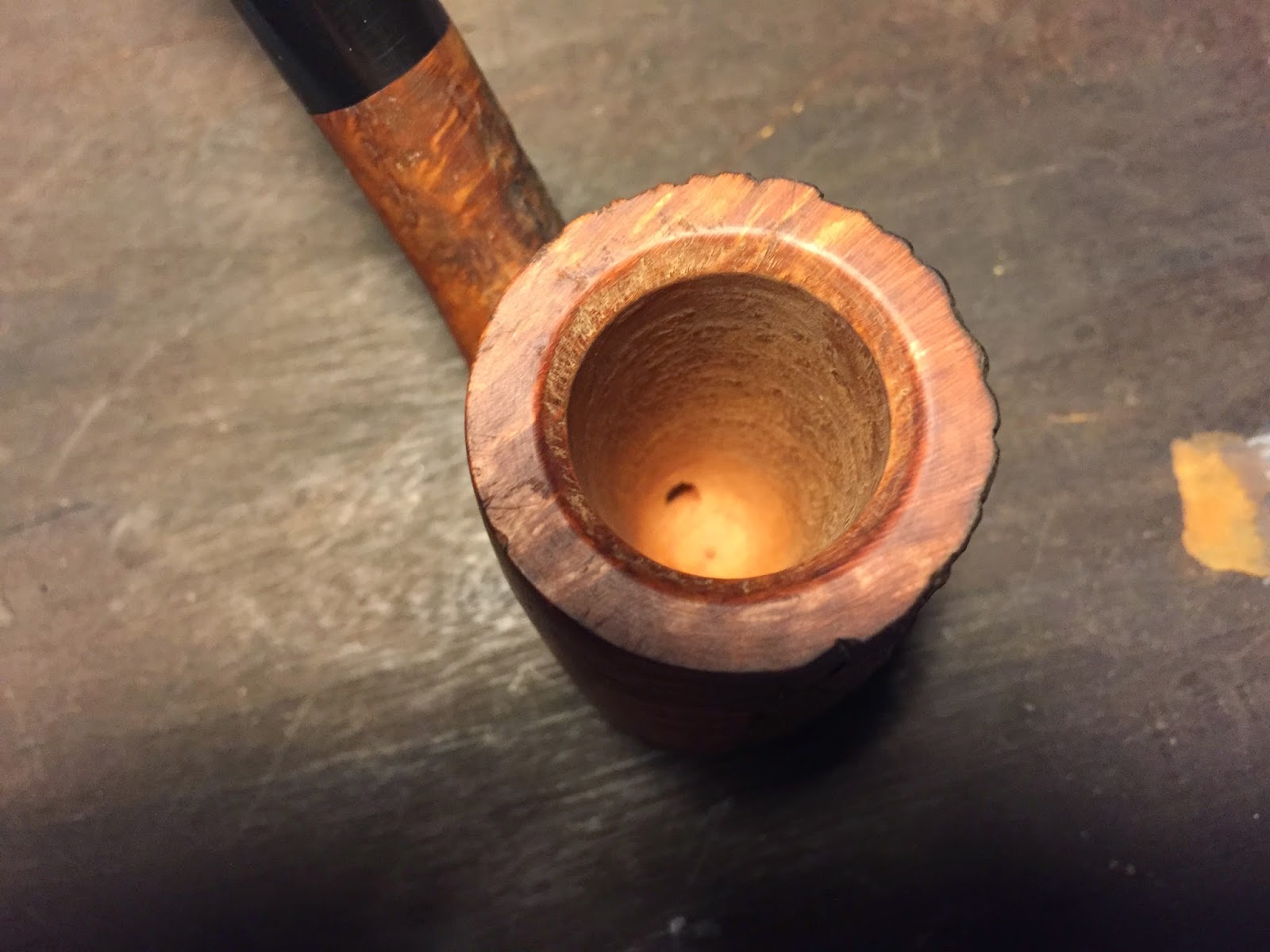


The fake classic shot.


Up next...some serioux free hand plateaux.


Regards from Lion city.

Comments

Popular posts from this blog

SHARPENING WITH ARKANSAS STONES

What on earth are they? A user made box of assorted Arkansas stones. They are America's answer to: The Wales' Welsh Slate (Dragon's Tongue); The Scotch Tam O'Shanter; The English Charnley Forest stone; The Japanese Tenin Toishi; The German Thuringian Hone; The Chinese Guangzhou River bedrock; The Belgian Coticule; You get the idea. Local rocks that you use to sharpen mama's kitchen knives.   A collection of smaller pocket-sized Arkansas stones  In this entry, I will not try to tell you what you probably already know. What is the point of describing that oily rock you already have under your bench, in your drawer, in a can of kerosene? Note also, that the sharpening I describe here is best applied to woodworking in general. I am an amateur handtool woodworker. Sharpening a straight razor would be entirely another branch of science. I do not profess to know all there is to know about sharpening or Arkansas stones; I simply failed ...

An Essential Pocket Knife : The Stockman

You're so right. I should be writing about Whittlers instead of Stockman knives. Afterall, this is a wood working blog. But do you whittle the whole day? Perhaps. Can you peel an apple with a whittler? Maybe, but not as well. What if you forgot the butter knife at a picnic, or you somehow need to spey or neuter an animal in an instant?.. (ok, I'm pulling your leg, but I'm referring to the ubiquitous spey blade in your stockman.) A stockman knife (Also called your Gandpa's EDC) will do all of the above with ease, and it will WHITTLE. My shallow pocket and minute brain says that Whittlers are for collectors. Try buying a Stag handled split-backsping whittler. They are not cheap. This is one of the forty stockmen I've purchased online. The other 39 are on their way. And yes, I have issues. The stockman bug maybe. Wait till my wife sees them: I like to imagine myself as a craftsman first, woodworker second. Now you see why I bought this brand. Looks so ...

10 Things I learnt about Arkansas Stones

10 things I learned about Arkansas stones Stones should be kept in their own box, or in a segregated box. This keeps out saw dust, and protects from stones knocking on each other, causing chips. 1)  Not for sharpening tools: Not a typing error too. I'm sure everyone has a dull knife or two in the kitchen. The type that will not cut meat or slice bread. You may be able to push-cut an apple, but that's all it'll do. Or that vintage ebay Marples chisel or that plane iron off a vintage Bailey. The edges on these tools will need to be dressed (chips ground-out, skew-edge squared, rolled-edge removed) and re-profiled (irregular and multiple bevel angles corrected) on a bench grinder or a coarse diamond plate, carborundum stones etc. All the above before it even touches an Arkansas stone. I have never met an Arkansas stone that can remove chips or correct bevel in less than 2 hours. Use Arkansas stones for honing and polishing. Old timers call it ...