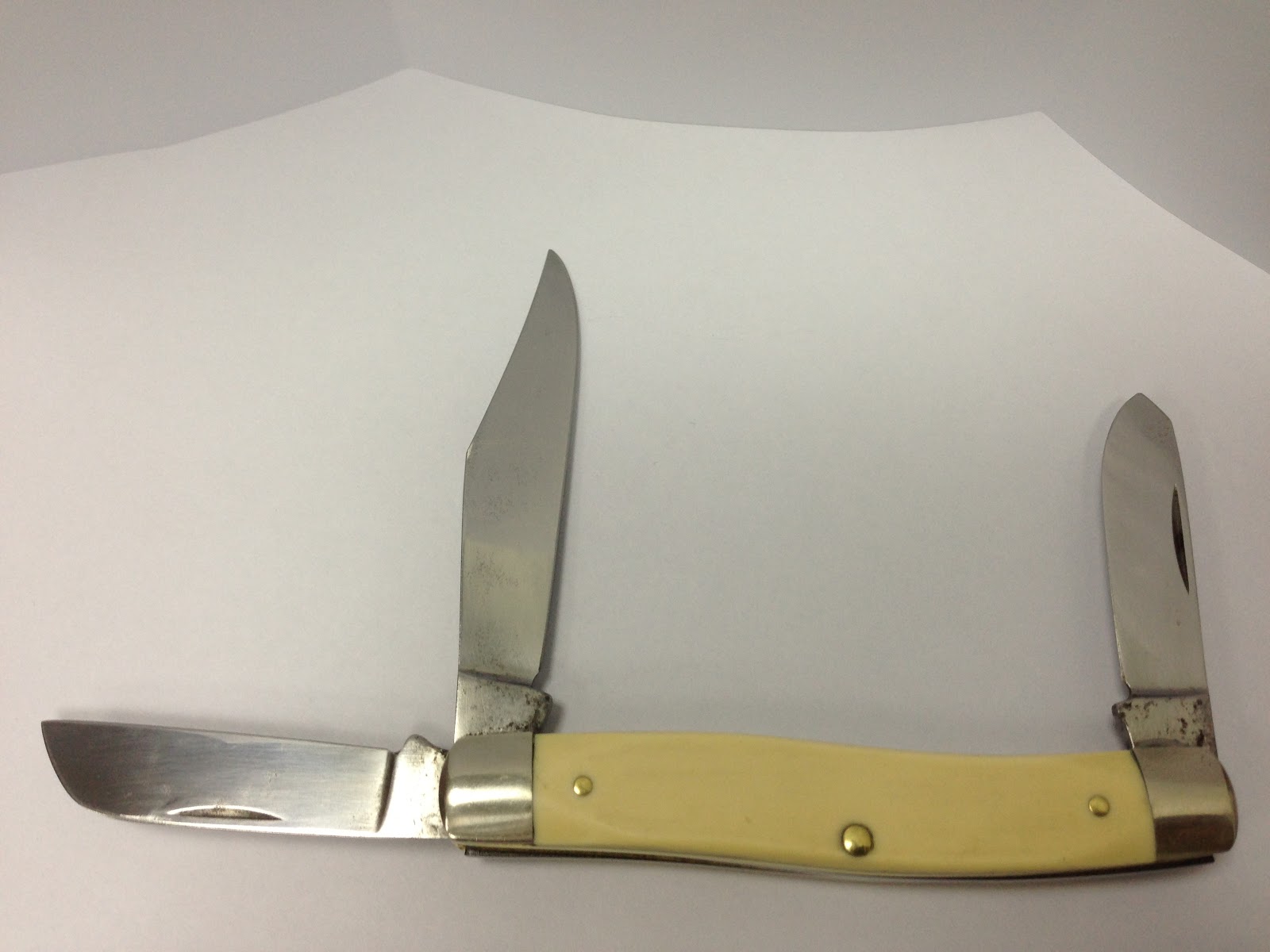
Polished blade resist moisture, cleans easier, not to mention looking nicer. (Note the blade-rubs. These are typical on even the best stockmans, resulting from blades touching one another on closing and opening in a tightly packed knife.)
When you get too carried away with sandpapers, leather and green polishing compound:
I still think the original patina looks better. Then again, this is a user.
Blade shapes in a stockman: Their uses and their upkeep.
The Clip point:
Clip point:
The longest of the trio, the clip does the most work, slicing meat, peeling fruits, dressing small game, filleting a fish, and whatever tasks that deems the blade handy. This example has a swedged top edge (false edge), and a long nail-pull. (This blade can be retouched on a soft arkansas or sharpened on the coarse side of a man made stone and finished on hard arkansas. This will give a polished micro serration to the edge, good for general slicing tasks)
The Sheepfoot
(Some folks calle them "Wharncliffs", or Coping blades, though the former are usually more raked and lower in profile)
Sheepfoot are meant for push cutting tasks, as suggested by their short length and almost straight cutting edge, like chopping (downward push) a thick rope on a raised block. They are similarly shaped as sailor's rigging knives, and are meant to be blunt at the point. The strong point is also handy for opening boxes, and shallow slitting on flat surfaces, like cutting out a newspaper article. Keep this blade honed on your finest stone.
....and finally, to Spay the Bitch, we have the.....you got it,..the
SPEY blade:
I do not think farmers or ranchers neuter or spay their lifestocks much with a pocket knife these days, if at all. But as the blade profile suggests, this is used to carefully slice through meat, with an almost 90 degree point to prevent puncturing a struggling animal's vital organs.
For tradition's sake, keep this knife reserved for the unexpected task, demanding the keenest edge.(In older CASE XX stockmans, this blade have an etching that reads" FOR FLESH ONLY"
Carefully hone this blade on your best stones and finish by stropping on leather.
DO NOT USE IT UNLESS YOU HAVE TO!
All men should carry some form of cutting implement.
So, grab a stockman Today, you cowboys (cowboys In a positive, handy sense)
I will also try...to do a post on cleaning old, cheap but well built carbon steel stockman knives so abundant online for the price of dirt. Carbon steel because ...do you use a stainless steel chisel for woodworking? and why?...Now you know. And notice how small my words are, on things I may not do even though I said I would.
Here are 2 Buck 301 Full sized Stockman that I picked up on ebay:
The recent model 301 that sports a laminated wood scales (dyed to look like cherry wood), the new 2 tone anvil logo in blue/silver, integrated nickel silver bolster/liner (one piece construction), slightly concaved wide primary bevel, 2 exposed scale rivets (curiously, the rivet for the back spring is hidden)This tang code dates this to year 2012. 420 HC stainless high carbon.
Buck Knives' Chairman,Chuck Buck's signature is proudly laser engraved on the reverse side.
Now, I bought the knife below because it has a long nail-notch (nail pull, nail nick, nail mark etc). And for that reason alone. I cannot recall seeing Buck using a long nail notch anywhere.This is an older pre-1986 Buck 301 that according to an expert in the AAPK site (Author's name:"300Bucks"), was made by Camillus for Buck.It seems like a credible theory, especially when you look at the grind (Flat ground), and the swedged false edge at the top of the main clip blade (note the stopped chamfer). All these are very unBucklike.
Black synthetic sawcut scales, with only the backspring rivet visible. The shield has a picture of a Buck knife being pounded by a hammer to cut a bolt. Buck's propaganda on it's famous heat-treatment on their steels. Is this 440C ?
The newer 301 has a more modern swedge at the clip, and also a crescent nail-notch like all other Buck folders.


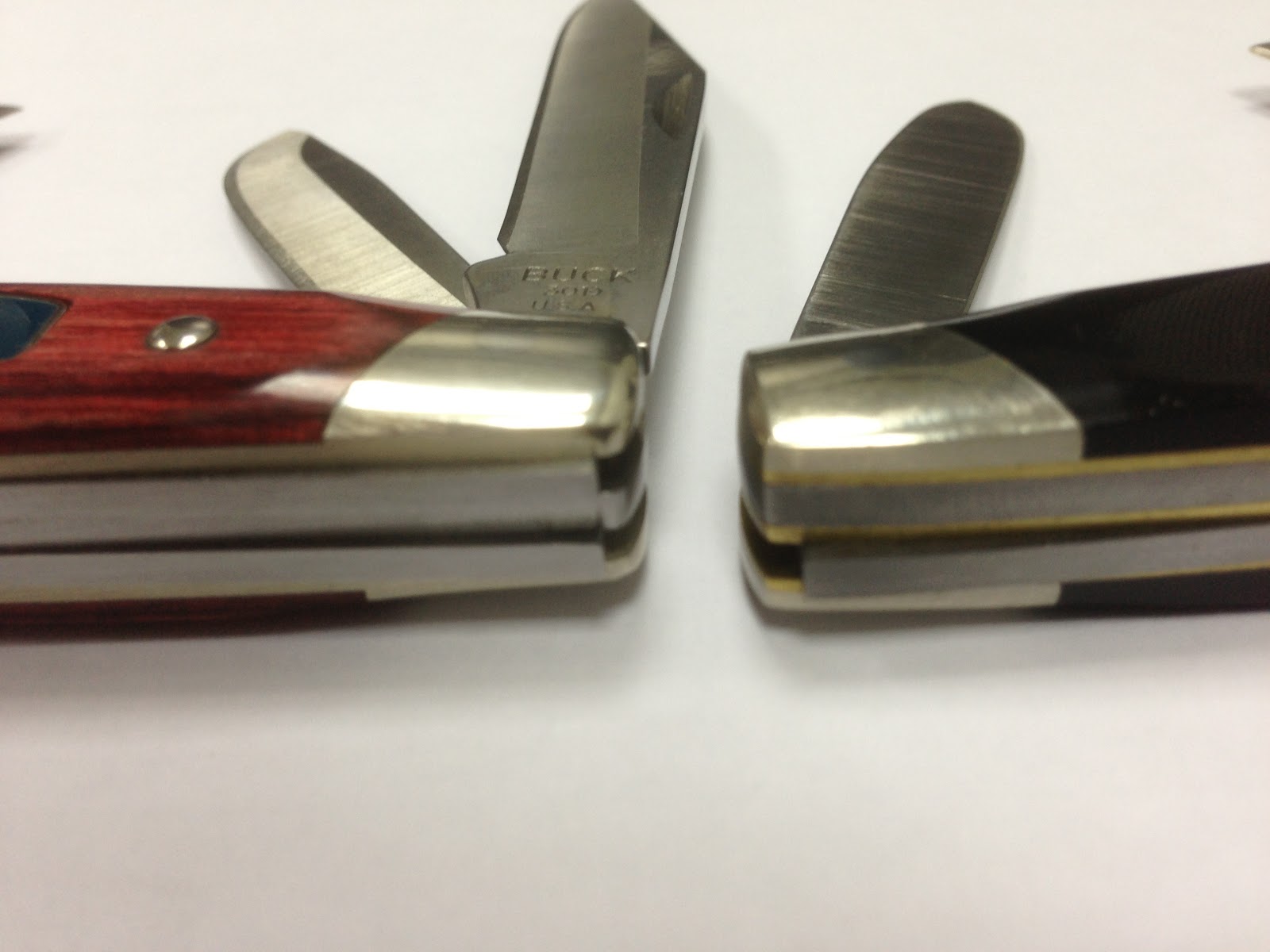
Another feature worth mentioning: The new Buck has one spring for EACH blade, while the older 301 uses the typical 3 blades to 2 spring configaration.Why? We all know that we should avoid opening both the spey and sheepsfoot at the same time, as they share a backsping and can jolly well break.My guess is buck added the spring to reduce a potential warranty problem. But.....how in the world did Buck manage to retain the overall thickness of the knife while adding another spring?! Well, they removed all the brass liner between the springs! All three of the liners. So how does this affect the "Walk"(smoothness of the tang-edge rubbing along the inside of back spring while knife is being opened/closed) and the "talk" (the snap-shut or snap-open click of the knife)? Not much. I was quite prepared to bust a thumbnail when I saw the one-blade to one-spring configuration. The knife opened with suprising ease and smoothness.
A Deviation from Tradition or a Conformation to Logic?
The spey blade has now changed sides, away from tradition.
To get my point, grab a stockman and do the following:
If you hold your stockman in your left hand, the first blade your right thumbnail catches will be the main clip blade. Flip the knife over in your left hand, and the first blade your thumbnail catches will be the spey. To get to the sheepsfoot, you will transfer the knife to your right and open the sheepsfoot with your left thumbnail. We are talking about ease here. You may say that you can easily open the sheepsfoot with your right hand, but when you are ready to make your cut, you will eventually transfer the opened knife to your right
The picture below is nothing more than a compromise in aesthetics. It is rather safe to run my fingers across exposed portion of the closed spey blade. The spey blade must remain on the outer side (and not sandwiched in the middle, as the sheepsfoot blade will then block the nail notch of the spey blade completely) About the only thing I don't like about the new 301. Buck could have lowered the spey blade's drop point so that the point is hidden.
PERHAPS BUCK WAS RIGHT. FOLKS DO NOT SPAY ANIMALS NOW, SO IT MADE SENSE TO MAKE THE SHEEPSFOOT THE MOST ACCESSIBLE BLADE WHEN YOU FLIP THE KNIFE. WE OPEN A LOT OF EBAY BOXES, DON'T WE?
COULD ANY ARTICLE ON POCKET KNIFE BE COMPLETE WITHOUT GIVING CASE XX KNIVES A MENTION?
I need to find out why a Case knife is a Case Knife. What is all the rage about. So I purchased a LARGE traditional bone scaled stockman. The model number is 6375 CV. CV steel is similar to carbon steel, but with Chrome and Vanadium added for edge retention and a little rust resistance. The color of the bone dye is amber, the jigging pattern is "Sawcut". The Mark side of the scale seems to imitate bones rough cut on a reciprocating saw blade (such as a bandsaw). The pile side suggests blanks cut on a circular saw. The blade are then riveted to the liners and flush polished at the bolster. The dye tries to imitate bones that were handled and pocket-worn for a few decades.
I believe some of your dollars goes to extra mirror polishing the back-springs. Note also the perfectly formed dome-shaped rivet head
Some reviewers complained about Case cutting costs by gluing on their shields, rather than pinning them as they did in the seventies and before. They say the shields are apt to fall out. This knife (of the Rancher" series), have no shield to fall out. Instead, the company logo is (laser?) engraved onto the bone scale.
The factory edge looks deceptively coarse. They are in fact, deliberately rough ground to produce micro-serrations. I was stupid enough to wipe the edge carelessly and open up my index finger.
| 






This comment has been removed by a blog administrator.
ReplyDeleteyalova
ReplyDeleteyozgat
elazığ
van
sakarya
358
bitlis
ReplyDeleteurfa
mardin
tokat
çorum
AEV2
ankara parça eşya taşıma
ReplyDeletetakipçi satın al
antalya rent a car
antalya rent a car
ankara parça eşya taşıma
3QJEQ
Maraş Lojistik
ReplyDeleteHatay Lojistik
Tokat Lojistik
Elazığ Lojistik
Aksaray Lojistik
OKWBDD
amasya evden eve nakliyat
ReplyDeleteeskişehir evden eve nakliyat
ardahan evden eve nakliyat
manisa evden eve nakliyat
karaman evden eve nakliyat
55P5D
E6F09
ReplyDeleteNiğde Parça Eşya Taşıma
Altındağ Fayans Ustası
Ünye Televizyon Tamircisi
Ünye Organizasyon
Çankırı Parça Eşya Taşıma
Hatay Evden Eve Nakliyat
Maraş Parça Eşya Taşıma
Eskişehir Şehir İçi Nakliyat
Ankara Parke Ustası
4CB29
ReplyDeleteBybit Güvenilir mi
Bursa Evden Eve Nakliyat
Sincan Fayans Ustası
Manisa Parça Eşya Taşıma
Afyon Parça Eşya Taşıma
İzmir Şehir İçi Nakliyat
Elazığ Şehirler Arası Nakliyat
Bilecik Şehir İçi Nakliyat
Adıyaman Evden Eve Nakliyat
C98F1
ReplyDeleteÇerkezköy Oto Elektrik
Poloniex Güvenilir mi
Ordu Parça Eşya Taşıma
Hatay Evden Eve Nakliyat
Yenimahalle Parke Ustası
Kastamonu Şehirler Arası Nakliyat
Balıkesir Şehirler Arası Nakliyat
Bayburt Şehirler Arası Nakliyat
Giresun Evden Eve Nakliyat
6FF68
ReplyDeleteSui Coin Hangi Borsada
Bolu Parça Eşya Taşıma
Aksaray Parça Eşya Taşıma
Tekirdağ Boya Ustası
Kırklareli Şehir İçi Nakliyat
Kırşehir Evden Eve Nakliyat
Sincan Fayans Ustası
Sonm Coin Hangi Borsada
Loop Network Coin Hangi Borsada
D826E
ReplyDeletehatay canlı sohbet et
bursa telefonda canlı sohbet
mersin ücretsiz sohbet
siirt yabancı canlı sohbet
kastamonu kadınlarla sohbet et
tunceli yabancı görüntülü sohbet uygulamaları
görüntülü sohbet siteleri
aydın bedava sohbet chat odaları
karaman bedava sohbet odaları
8218B
ReplyDeleteBitcoin Oynama
Binance Referans Kodu
Kripto Para Oynama
Pepecoin Coin Hangi Borsada
Kwai Beğeni Hilesi
Referans Kimliği Nedir
Binance Referans Kodu
Arg Coin Hangi Borsada
Bitcoin Nasıl Alınır
شركة تسليك مجاري بالهفوف nH5yoMJ4Pa
ReplyDeleteشركة تنظيف خزانات aDuhojSoZJ
ReplyDeleteشركة تسليك مجاري بالاحساء yPfha2U0rE
ReplyDelete4A44C95CA1
ReplyDeletegarantili türk takipçi
8D5E07FFC5
ReplyDeletetakipçi paketleri
DD9271111F
ReplyDeletetiktok takipçi
F0A270F43D
ReplyDeletetürk takipçi
telafili takipçi
telafili takipçi
TL Trafik Cezası Nedir
TL Trafik Cezası Nedir
Love With Flaws Konusu
Kafa Topu Elmas Kodu
Cerca Trova Nedir
Trafik Cezaları
EC28915ABA
ReplyDeletemobil ödeme tiktok takipçi
youtube beğeni satın al
fake takipçi
telafili takipçi
aktif takipçi
09980B40B2
ReplyDeletetiktok takipçi al
begeni satin al
ig takipçi
bayan takipçi
takipçi
महाकालसंहिता कामकलाकाली खण्ड पटल १५ - कामकलाकाल्याः प्राणायुताक्षरी मन्त्रः
ReplyDeleteओं ऐं ह्रीं श्रीं ह्रीं क्लीं हूं छूीं स्त्रीं फ्रें क्रों क्षौं आं स्फों स्वाहा कामकलाकालि, ह्रीं क्रीं ह्रीं ह्रीं ह्रीं हूं हूं ह्रीं ह्रीं ह्रीं क्रीं क्रीं क्रीं ठः ठः दक्षिणकालिके, ऐं क्रीं ह्रीं हूं स्त्री फ्रे स्त्रीं ख भद्रकालि हूं हूं फट् फट् नमः स्वाहा भद्रकालि ओं ह्रीं ह्रीं हूं हूं भगवति श्मशानकालि नरकङ्कालमालाधारिणि ह्रीं क्रीं कुणपभोजिनि फ्रें फ्रें स्वाहा श्मशानकालि क्रीं हूं ह्रीं स्त्रीं श्रीं क्लीं फट् स्वाहा कालकालि, ओं फ्रें सिद्धिकरालि ह्रीं ह्रीं हूं स्त्रीं फ्रें नमः स्वाहा गुह्यकालि, ओं ओं हूं ह्रीं फ्रें छ्रीं स्त्रीं श्रीं क्रों नमो धनकाल्यै विकरालरूपिणि धनं देहि देहि दापय दापय क्षं क्षां क्षिं क्षीं क्षं क्षं क्षं क्षं क्ष्लं क्ष क्ष क्ष क्ष क्षः क्रों क्रोः आं ह्रीं ह्रीं हूं हूं नमो नमः फट् स्वाहा धनकालिके, ओं ऐं क्लीं ह्रीं हूं सिद्धिकाल्यै नमः सिद्धिकालि, ह्रीं चण्डाट्टहासनि जगद्ग्रसनकारिणि नरमुण्डमालिनि चण्डकालिके क्लीं श्रीं हूं फ्रें स्त्रीं छ्रीं फट् फट् स्वाहा चण्डकालिके नमः कमलवासिन्यै स्वाहालक्ष्मि ओं श्रीं ह्रीं श्रीं कमले कमलालये प्रसीद प्रसीद श्रीं ह्रीं श्री महालक्ष्म्यै नमः महालक्ष्मि, ह्रीं नमो भगवति माहेश्वरि अन्नपूर्णे स्वाहा अन्नपूर्णे, ओं ह्रीं हूं उत्तिष्ठपुरुषि किं स्वपिषि भयं मे समुपस्थितं यदि शक्यमशक्यं वा क्रोधदुर्गे भगवति शमय स्वाहा हूं ह्रीं ओं, वनदुर्गे ह्रीं स्फुर स्फुर प्रस्फुर प्रस्फुर घोरघोरतरतनुरूपे चट चट प्रचट प्रचट कह कह रम रम बन्ध बन्ध घातय घातय हूं फट् विजयाघोरे, ह्रीं पद्मावति स्वाहा पद्मावति, महिषमर्दिनि स्वाहा महिषमर्दिनि, ओं दुर्गे दुर्गे रक्षिणि स्वाहा जयदुर्गे, ओं ह्रीं दुं दुर्गायै स्वाहा, ऐं ह्रीं श्रीं ओं नमो भगवत मातङ्गेश्वरि सर्वस्त्रीपुरुषवशङ्करि सर्वदुष्टमृगवशङ्करि सर्वग्रहवशङ्करि सर्वसत्त्ववशङ्कर सर्वजनमनोहरि सर्वमुखरञ्जिनि सर्वराजवशङ्करि सर्वलोकममुं मे वशमानय स्वाहा, राजमातङ्ग उच्छिष्टमातङ्गिनि हूं ह्रीं ओं क्लीं स्वाहा उच्छिष्टमातङ्गि, उच्छिष्टचाण्डालिनि सुमुखि देवि महापिशाचिनि ह्रीं ठः ठः ठः उच्छिष्टचाण्डालिनि, ओं ह्रीं बगलामुखि सर्वदुष्टानां मुखं वाचं स्त म्भय जिह्वां कीलय कीलय बुद्धिं नाशय ह्रीं ओं स्वाहा बगले, ऐं श्रीं ह्रीं क्लीं धनलक्ष्मि ओं ह्रीं ऐं ह्रीं ओं सरस्वत्यै नमः सरस्वति, आ ह्रीं हूं भुवनेश्वरि, ओं ह्रीं श्रीं हूं क्लीं आं अश्वारूढायै फट् फट् स्वाहा अश्वारूढे, ओं ऐं ह्रीं नित्यक्लिन्ने मदद्रवे ऐं ह्रीं स्वाहा नित्यक्लिन्ने । स्त्रीं क्षमकलह्रहसयूं.... (बालाकूट)... (बगलाकूट )... ( त्वरिताकूट) जय भैरवि श्रीं ह्रीं ऐं ब्लूं ग्लौः अं आं इं राजदेवि राजलक्ष्मि ग्लं ग्लां ग्लिं ग्लीं ग्लुं ग्लूं ग्लं ग्लं ग्लू ग्लें ग्लैं ग्लों ग्लौं ग्ल: क्लीं श्रीं श्रीं ऐं ह्रीं क्लीं पौं राजराजेश्वरि ज्वल ज्वल शूलिनि दुष्टग्रहं ग्रस स्वाहा शूलिनि, ह्रीं महाचण्डयोगेश्वरि श्रीं श्रीं श्रीं फट् फट् फट् फट् फट् जय महाचण्ड- योगेश्वरि, श्रीं ह्रीं क्लीं प्लूं ऐं ह्रीं क्लीं पौं क्षीं क्लीं सिद्धिलक्ष्म्यै नमः क्लीं पौं ह्रीं ऐं राज्यसिद्धिलक्ष्मि ओं क्रः हूं आं क्रों स्त्रीं हूं क्षौं ह्रां फट्... ( त्वरिताकूट )... (नक्षत्र- कूट )... सकहलमक्षखवूं ... ( ग्रहकूट )... म्लकहक्षरस्त्री... (काम्यकूट)... यम्लवी... (पार्श्वकूट)... (कामकूट)... ग्लक्षकमहव्यऊं हहव्यकऊं मफ़लहलहखफूं म्लव्य्रवऊं.... (शङ्खकूट )... म्लक्षकसहहूं क्षम्लब्रसहस्हक्षक्लस्त्रीं रक्षलहमसहकब्रूं... (मत्स्यकूट ).... (त्रिशूलकूट)... झसखग्रमऊ हृक्ष्मली ह्रीं ह्रीं हूं क्लीं स्त्रीं ऐं क्रौं छ्री फ्रें क्रीं ग्लक्षक- महव्यऊ हूं अघोरे सिद्धिं मे देहि दापय स्वाहा अघोरे, ओं नमश्चा ameya jaywant narvekar
Dedicated Firefighter Loses $450K to Romance Scam…
ReplyDelete.
.
I lived to serve—rushing into fires, long shifts, buying gear myself, saving $450K over years for my son’s future and retirement after losing my wife. Then ‘Emily’ connected online—warm, supportive, a supposed humanitarian aid worker in crisis zones. She shared her brave days, called me her rock, made me feel alive again. She empathized with my risks and exhaustion, built trust gently. Then emergencies hit: her “brother’s” life-saving operation, a quick investment for our future home. She showed “verified” crypto profits. I trusted our bond and sent everything—wires, crypto, pension cash-out. It vanished. Crushed, I locked myself in the station locker room after a call, sank sobbing, convinced I’d failed my crew, my son, and our life. Late one night, broken, I found JetWebHackers. I messaged in tears. They responded fast, traced the blockchain, fought hard. In weeks, full $450K recovered—funds hit my account. I stared at the screen, gripping my helmet, tears of raw relief streaming. They restored my fight and hope. If a scammer stole your heart and savings, don’t give up—JetWebHackers are real heroes who never quit on victims. Thank you from my soul! God bless.
#JetWebHackers
EMAIL: support@jetwebhackers.com
WhatsApp: +1 (260) 228-9998