Hardware for Workbench- Off-the-shelf

The 250 lb or so of lumber sitting atop my tiny bench, waiting to be finished.


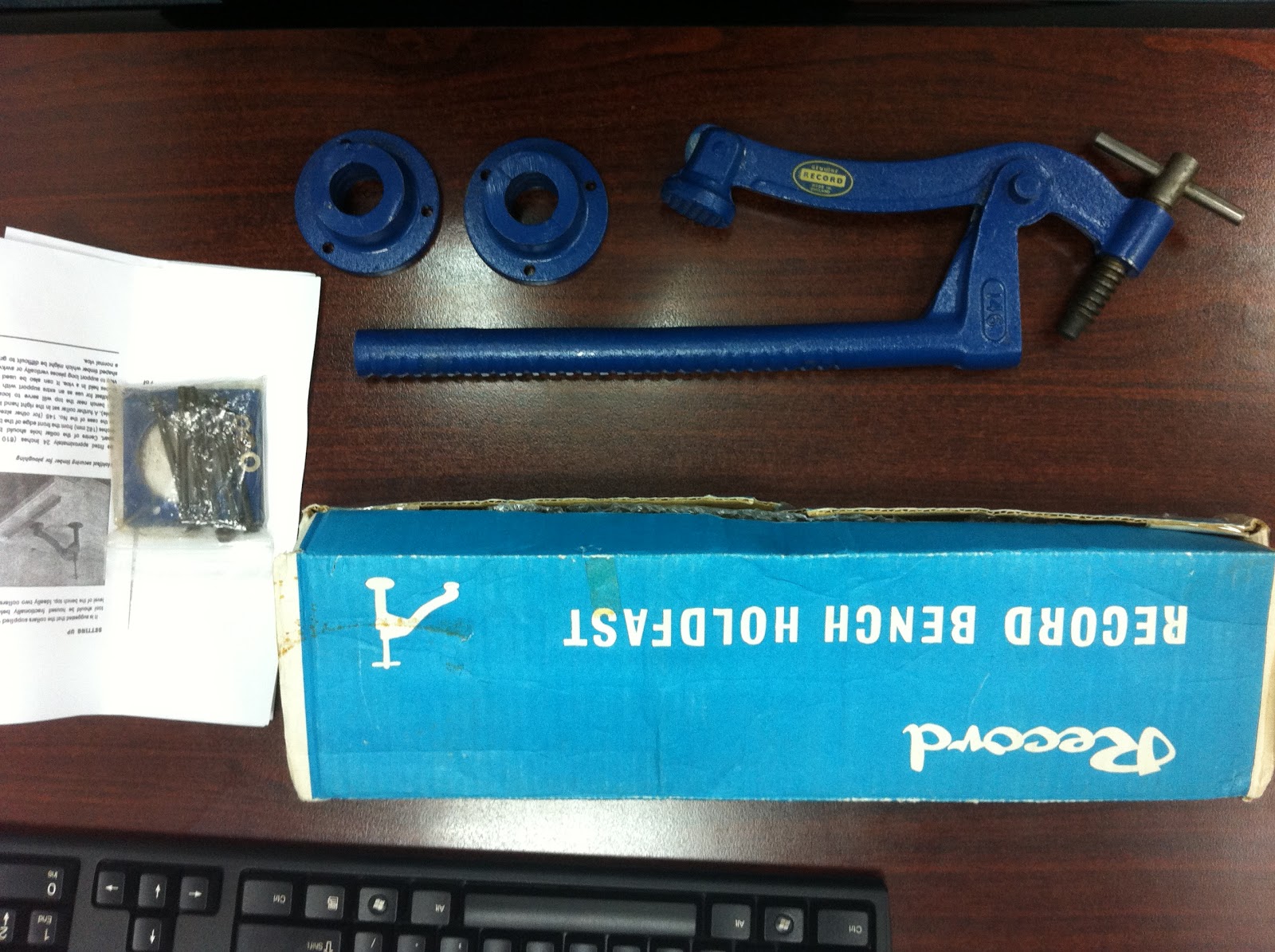
Record made many useful bench accessories, among them the iconic Record 52 1/2 D woodworking vise. The No. 146 Bench holdfast is another useful fitting on a bench.

Shown here: one of the two heavy collars supplied with the holdfast.

Seller is kind enough to include the installation instructions

Bench stops like these were no longer produced by record. For the record, I could have simply used a piece of wood and some winged-nuts against a bench leg to achieve the same effect, but I bought it just because it was stove enamel blue Record....just for the heck of it.

To install this bench stop, a mortise has to be made at the bench top to receive the beechwood stop. The whole assembly is usually butted against a bench leg on the flat side.
The other view of the bench stop: the flat side usually butted against a bench leg.

The legend in its third or fourth incarnation: Now Irwin-Record.


Some C-Clamps to complement the workholding arsenal.

These 3/8" bolts will be cut as tie-bolts for the top, and also stretcher bolts.
A mock-up of the workbench.

Comments

Popular posts from this blog

SHARPENING WITH ARKANSAS STONES

What on earth are they? A user made box of assorted Arkansas stones. They are America's answer to: The Wales' Welsh Slate (Dragon's Tongue); The Scotch Tam O'Shanter; The English Charnley Forest stone; The Japanese Tenin Toishi; The German Thuringian Hone; The Chinese Guangzhou River bedrock; The Belgian Coticule; You get the idea. Local rocks that you use to sharpen mama's kitchen knives.   A collection of smaller pocket-sized Arkansas stones  In this entry, I will not try to tell you what you probably already know. What is the point of describing that oily rock you already have under your bench, in your drawer, in a can of kerosene? Note also, that the sharpening I describe here is best applied to woodworking in general. I am an amateur handtool woodworker. Sharpening a straight razor would be entirely another branch of science. I do not profess to know all there is to know about sharpening or Arkansas stones; I simply failed ...

10 Things I learnt about Arkansas Stones

10 things I learned about Arkansas stones Stones should be kept in their own box, or in a segregated box. This keeps out saw dust, and protects from stones knocking on each other, causing chips. 1)  Not for sharpening tools: Not a typing error too. I'm sure everyone has a dull knife or two in the kitchen. The type that will not cut meat or slice bread. You may be able to push-cut an apple, but that's all it'll do. Or that vintage ebay Marples chisel or that plane iron off a vintage Bailey. The edges on these tools will need to be dressed (chips ground-out, skew-edge squared, rolled-edge removed) and re-profiled (irregular and multiple bevel angles corrected) on a bench grinder or a coarse diamond plate, carborundum stones etc. All the above before it even touches an Arkansas stone. I have never met an Arkansas stone that can remove chips or correct bevel in less than 2 hours. Use Arkansas stones for honing and polishing. Old timers call it ...

A Case for Chisels: Stanley 5000 series

“Life being very short, and the quiet hours of it few, we ought to waste none of them in reading valueless books.” -John Ruskin. Substitute the word "books" with "blogs", and perhaps you should stop reading. I did my part and you are warned. No, I can't refund 4 minutes of your life. F or the most part of my woodworking life, I've kept my loose chisels in felt lined drawers. (I mean excess chisels purchased on impulse: Those of cast steel, those of boxwood, those octagonal London snobs, those ergo grips that promises an orgasm with each mortise, the socketed, the tanged, the handle-less tangs, the long paring ones, those curious crank-necks, the basic pig stickers, the vintage ferrule-less-...you know. I know. Some folks have too many hammers or smoothing planes or trammels. I'm a chisel guy. But the ones that are constantly on the move live in a canvas tool roll. I like the look of a chisel roll, except that the edges tend to slice the...